There has been a lot of conversation in recent years about artificial intelligence–specifically, the fear of job displacement and the loss of the ‘human touch’ in creative industries. In the world of skincare and cosmetics, however, AI is emerging not as a replacement for human values, but rather as the ultimate enabler of them.
For decades, the clean beauty movement has faced a massive hurdle: data overload. With thousands of chemicals on the market, manually vetting ingredients for human safety and environmental impact can be both overwhelming and time-consuming.
The Digital Transformation of Safety
This is where the ‘bright side’ of AI comes into play. Major industry players are proving that AI can be harnessed to protect both human health and the planet by filtering out harmful chemistry faster than ever before.
Shiseido Takes the Lead
A prime example of this technological leap comes from Shiseido. The beauty giant recently unveiled two AI-driven technologies designed to tackle the two biggest challenges in product development: biodegradability and safety assessment.
Biodegradability
Traditionally, figuring out how quickly an ingredient breaks down in the environment requires time-consuming, costly lab tests. Shiseido has collaborated with Japans’s National Institute of Technology and Evaluation to change that. By leveraging an AI-based quantitative structure-activity relationship (AI-QSAR) model, they can now predict the biodegradability of an ingredient based solely on its chemical structure.
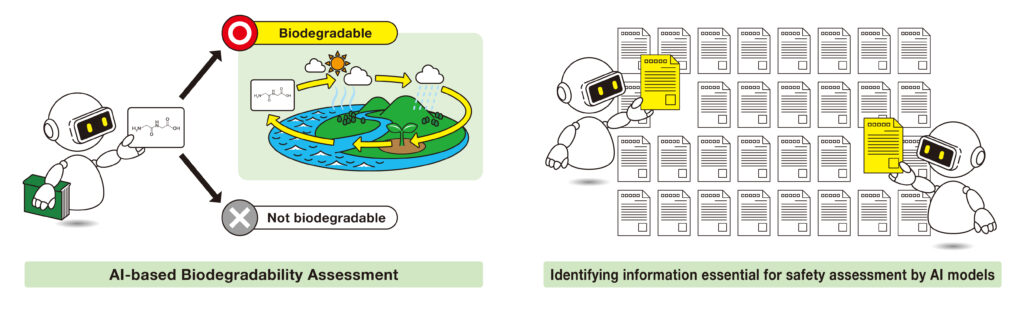
Image courtesy of Shiseido
This shift is monumental for the circular economy. It allows formulators to instantly identify ingredients that will “return to a natural state,” accelerating the industry’s move away from persistent pollutants and toward bio-based solutions. This aligns with the broader market shift we are seeing from ingredient suppliers like Eastman and Kolmar Korea, who are increasingly turning to tree-derived cellulose and biodegradable polymers to meet consumer demand for sustainable products.
Human Safety
The second tool addresses the regulatory mountain that clean beauty brands climb daily. Shiseido’s new AI system scans vast datasets to identify safety information on cosmetic ingredients, including repeated-dose toxicity and skin sensitization data.
This technology does not replace the safety expert, but rather it empowers them. By automating the data collection, AI reduces the risk of human oversight and bias. This allows chemists and toxicologists to focus on the nuanced work of final safety decisions and innovation. Perhaps most excitingly, Shiseido notes that this system can rehabilitate ingredients that were previously discarded simply due to a lack of available information, paving the way for a wider, safer palette of materials.
A Future Built on Data
As regulatory bodies globally—from New Zealand to Nigeria—tighten their rules to align with stricter frameworks (like the EU’s), the need for robust data is no longer optional.
Initiatives like the one from Shiseido prove that AI can be a powerful ally in the clean beauty movement. AI helps ensure that the products we put on our skin are held to the highest standard of health and environmental integrity.
The future of beauty isn’t just clean—it’s intelligent.
Edited to Add
While AI can be used as a powerful transparency tool in the beauty industry, it can also be used unethically. See the more recent article Worse than Airbrushing: The Rise of AI Beauty Ads